NeuroTopo
An artist-controlled retopology environment that combines fast Houdini interaction with recoverable geometry editing and bounded AI assistance.
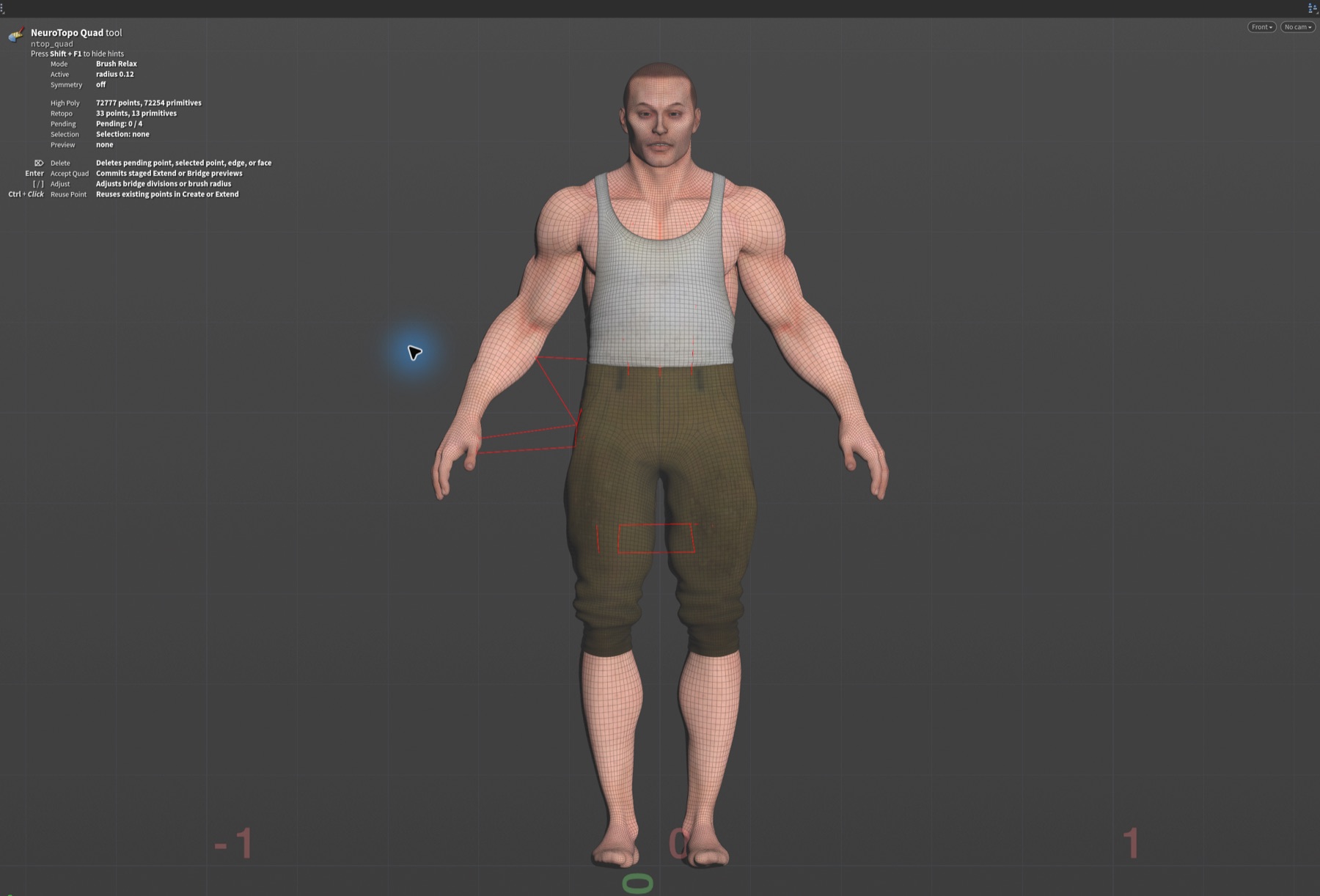
Why I built it
Retopology contains repetitive mechanical work, but the result remains an authored object. A useful tool must reduce effort without making consequential topology decisions invisible to the artist.
I built NeuroTopo as a practical retopology environment first, then used that working foundation to define where topology intelligence can assist without becoming a second author.
The product problem
Interactive geometry must feel immediate while preserving legality, projection, history, and recovery. A fast preview is not sufficient if releasing the gesture can publish invalid or stale topology.
The architectural challenge was to separate responsive preview from authoritative mutation, then introduce semantic and quality providers without creating competing sources of truth.
How I approached it
Keep previews separate from durable geometry. A gesture can feel immediate, but the final edit is published only after it has been conformed, checked, and recorded.
Run geometry, topology, and spatial work in native code so Houdini stays responsive, while Python remains a thin integration layer.
Give AI helpers frozen geometry snapshots and strict execution limits. They can analyze and suggest through defined interfaces, but they cannot write directly to the artist’s mesh.
How the product works
- 01
Resolve the gesture
One interaction resolver maps Houdini input, authoring state, modifiers, and hover target to one semantic action.
- 02
Preview locally
Persistent native contexts update only the affected neighborhood and retained drawables; preview state cannot author durable topology.
- 03
Commit atomically
Release conforms, validates, stages one native transaction, compares exact state authority, and either publishes one legal result or nothing.
- 04
Recover and verify
A portable hash-chained state journal, checkpoints, verified materialization, and bounded diagnostics keep the runtime recoverable.
Decisions that make it different
Artist authority is non-negotiable
Prediction proposes, inferred semantics never overwrite authored semantics, and manual interactions still work when optional intelligence is unavailable.
A preview is not the final mesh
Interactive feedback stays fast because the durable geometry is checked and published only when the gesture ends.
Intelligence gets a narrow doorway
AI helpers receive a fixed snapshot and a bounded task, then return a proposal rather than changing the mesh themselves.
What I built
- A working Houdini retopology workflow for drawing, extending, relaxing, splitting, cleaning, and validating geometry.
- Atomic edits with stable geometry identities, legal-state checks, recoverable publication, and a portable history.
- Native geometry contexts that keep interactive previews responsive while limiting updates to the affected region.
- A bounded extension layer for topology analysis and suggestions without direct write access to the mesh.
How it fits the lab
NeuroTopo separates suggestion from authorship. Intelligence can propose or evaluate, but the artist remains the only authority that commits topology.
The project also connects interface feel to system design: responsive previews and durable mesh edits follow different paths so speed never becomes a substitute for correctness.
Product and technical scope
I defined the product and interaction model, built the native and Python architecture, implemented the geometry system, and validated performance and Houdini integration.